For more than a century, paper business cards have been a symbol of professionalism and personal connection. Handing over a card after a meeting has long been seen as a polite ritual in business culture. However, in today’s world where sustainability, climate awareness, and responsible consumption matter more than ever the environmental cost of paper business cards is difficult to ignore. What once felt essential now raises serious questions about waste, resource depletion, and long-term impact on the planet.
Modern professionals are beginning to realize that the traditional card exchange comes with hidden environmental and financial costs. From deforestation to chemical pollution, the lifecycle of a paper business card is far from harmless. And because most cards have an extremely short lifespan, the damage accumulates rapidly across industries and countries.
The Problem with Paper Industry
The environmental concerns surrounding paper business cards start at the very beginning: paper production itself. The global paper industry is one of the largest consumers of wood pulp, water, and energy. According to industry reports, paper manufacturing accounts for roughly 2% of global industrial carbon emissions. Large-scale logging operations feed this demand, often leading to habitat destruction and biodiversity loss.
In many regions, forests are cleared faster than they can regenerate. While some paper comes from managed forests, a significant portion still contributes to deforestation. The process also requires enormous quantities of water and electricity. For example, producing just one ton of paper can consume up to 20,000 gallons of water and several megawatt hours of energy. When multiplied by the billions of business cards printed annually, the environmental burden becomes staggering.
High Paper Waste and Short Lifespan
One of the most troubling aspects of paper business cards is how quickly they become waste. Research from marketing associations suggests that nearly 88% of paper business cards are thrown away within a week of being received. Many end up forgotten in drawers, lost in bags, or discarded during office clean-ups.
Imagine attending a large trade show. A sales representative might distribute 500 cards in a single day. By the end of the week, most of those cards will be in recycling bins or worse, landfills. A real estate agent in a busy urban area may order thousands of cards annually, yet only a small fraction leads to actual business relationships.
Deforestation and Loss of Natural Resources
Forests play a crucial role in absorbing carbon dioxide, supporting wildlife, and maintaining ecological balance. When trees are cut down for paper production, this natural carbon sink is weakened. Deforestation also disrupts indigenous communities and accelerates soil erosion and climate change.
Even recycled paper requires energy and water to process, meaning the environmental impact never fully disappears. While recycled cards are better than virgin paper, they still contribute to resource consumption. The demand for fresh cards year after year prevents meaningful reduction in forest exploitation.
Pollution from Printing Inks and Chemicals
Paper alone is not the only environmental concern. Printing introduces another layer of pollution. Traditional inks often contain petroleum-based solvents, heavy metals, and volatile organic compounds (VOCs). These chemicals can contaminate air and water during production and disposal.
In printing facilities, chemical runoff can enter local waterways if not properly treated. Workers may also be exposed to hazardous substances over time. Even soy-based inks, considered a greener option, still involve processing and transportation emissions.
Carbon Emissions from Production and Transportation
Every stage of a paper business card’s journey produces carbon emissions. Trees must be harvested and transported to mills. Pulp is processed using energy-intensive machinery. Finished paper travels to printing facilities, then to distribution centers, and finally to customers.
International companies often outsource printing to other countries to reduce costs, increasing shipping distances. Air freight, in particular, has a significant carbon footprint. When thousands of businesses reorder cards multiple times per year, the cumulative emissions become substantial.
Frequent Reprinting Creates Additional Waste
Unlike digital information, printed cards cannot be easily updated. A new phone number, job title, logo redesign, or office relocation quickly makes existing cards outdated, forcing businesses to reorder while discarding unused stock. Even perfectly good cards often end up in the trash simply because the details are no longer accurate.
This issue is especially common in fast-growing companies where roles, teams, and branding change frequently. The cycle of printing, updating, and disposing repeats across industries, creating unnecessary waste and ongoing expenses.
To put this into perspective, research estimates that around, 100 billion paper business cards are produced worldwide each year. Producing this volume consumes large amounts of wood, water, energy, and chemical-based inks, meaning vast resources are used for items that are often thrown away within a short time.
Limited Functionality Compared to Digital Business Cards
Beyond environmental concerns, paper cards also offer limited usefulness. They cannot display videos, portfolios, social media links, or real-time updates. If a recipient loses the card, the connection is gone. There is no analytics, no interaction tracking, and no way to know whether the contact information was ever used.
In contrast, modern networking demands dynamic communication. Professionals increasingly rely on digital platforms that allow instant updates, multimedia content, and seamless follow-up. Paper cards simply cannot compete with this level of functionality.
Higher Long-Term Costs for Businesses
While printing paper cards may seem inexpensive upfront, the long-term costs add up quickly. Designing, printing, shipping, and reordering cards year after year can cost businesses hundreds or even thousands of dollars per employee. On average, a standard batch of 500 professionally printed cards costs between $20 and $60, but higher-quality designs with thicker stock, custom finishes, or color printing typically range from $80 to $200 per order. Premium options such as embossed lettering, foil stamping, spot UV coating, or textured paper can push the price to $250–$500 per batch. When employees reorder multiple times per year due to role changes, depleted stock, or updated branding, annual spending rises significantly.
A mid-sized company with 100 employees might easily spend $8,000 to $20,000 per year on business cards alone, depending on quality and reorder frequency. For large corporations, this figure can climb well beyond $50,000 annually. When factoring in wasted cards, outdated information, storage, and rush shipping fees for urgent reprints, the financial inefficiency becomes even more apparent. Over time, what appears to be a small operational expense turns into a substantial recurring cost with very little long-term value.
The Smarter Alternatives to Paper Business Cards
As environmental awareness grows, professionals are turning toward smarter, more sustainable networking solutions. Technology now allows contact information to be shared instantly without consuming physical resources. These alternatives not only reduce environmental impact but also improve efficiency and engagement.
Digital Business Cards: The Most Sustainable Option
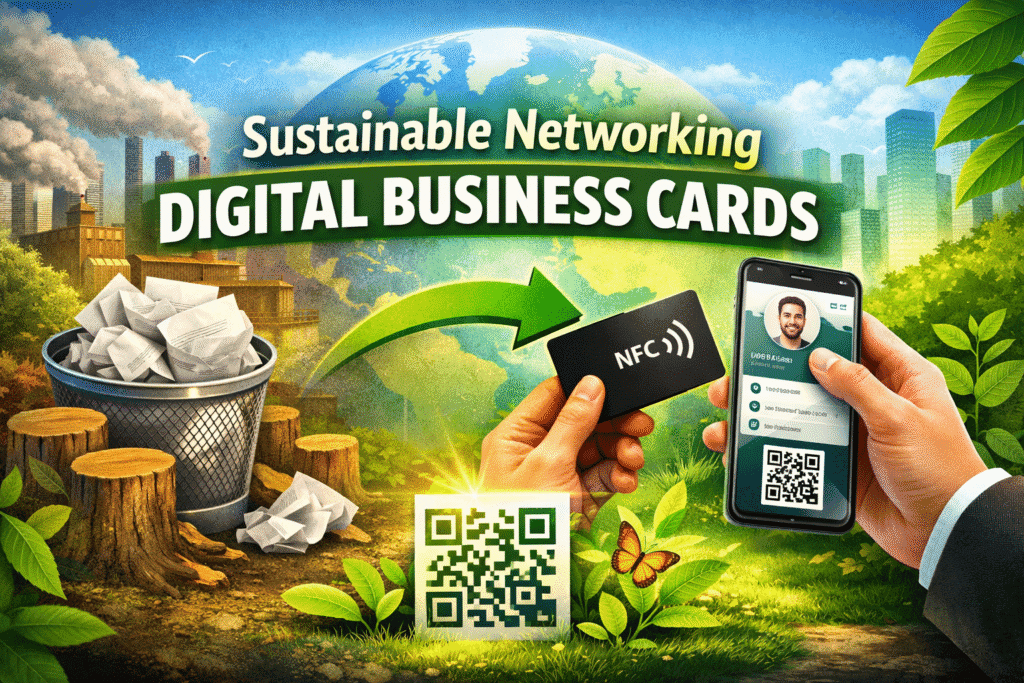
Digital business cards represent the most eco-friendly replacement for paper cards. Stored online or within an app, they eliminate the need for printing, shipping, and physical disposal. A single digital card can be shared thousands of times without generating waste.
Real-world adoption is accelerating. Many consultants, freelancers, and corporate teams now use digital cards during virtual meetings, conferences, and client interactions. Instead of handing out paper, they simply send a link, scan a code, or tap a device. In addition to fully digital profiles, reusable physical options such as Metal cards, Bamboo cards, and Creatively Designed 3D cards are also gaining popularity. These durable cards often include NFC chips or QR code, allowing professionals to share their digital information instantly while using a single card for years.
From a sustainability perspective, the benefits are significant. No trees are cut down for repeated printing, no ink is required for every exchange, and updates can be made instantly without producing new materials. Because one reusable card can replace thousands of disposable paper cards, this approach dramatically reduces waste, lowers environmental impact, and cuts long-term operational costs while still delivering a premium, memorable networking experience.
Solutions like UINQO offer an intuitive platform designed for professionals, small teams, and large organizations that want a smarter, more sustainable way to network. Start UINQO for free and discover how easily you can share, manage, and grow your connections in a modern, eco-friendly way.
NFC Enabled Smart Cards for Instant Sharing
Near Field Communication (NFC) technology allows information to be transferred with a simple tap between devices. NFC smart cards look like traditional cards but contain a chip that links to a digital profile. Because they are reusable, one card can replace thousands of paper versions.
For example, a technology executive attending international conferences can use the same NFC card for years. Instead of carrying stacks of printed cards, a single tap instantly shares updated contact details. This reduces waste while projecting a modern, innovative image.
QR Code Digital Cards for Fast Contact Exchange
QR code provide another efficient sharing method. Recipients simply scan the code with their smartphone camera to access contact information, websites, or portfolios. QR code can be displayed on phones, presentation slides, email signatures, or badges, eliminating the need for physical distribution.
During the pandemic, QR code became widely accepted for menus and check-ins. That familiarity has made them an easy transition for professional networking as well. A marketing manager presenting at a seminar, for instance, can display a QR code on the final slide, allowing hundreds of attendees to connect instantly.
Mobile Wallet Passes (Apple/Google Wallet)
Mobile wallet passes integrate digital business cards directly into smartphone wallets. Once saved, the contact information is always accessible, even offline. Notifications can remind users of updates, events, or follow-ups, strengthening long-term engagement.
Sales professionals find this particularly useful. A client who saves a wallet pass is less likely to forget the contact compared to a paper card buried in a drawer. This improves conversion rates while maintaining sustainability.
How UINQO Helps Solve These Problems
Platforms like UINQO demonstrate how digital solutions can replace traditional cards while enhancing networking effectiveness. By providing smart digital business cards with analytics, customization, and instant sharing options, UINQO eliminates the need for repeated printing and distribution.
Instead of wasting resources on disposable cards, professionals can maintain a single dynamic profile that evolves with their career. UINQO’s smart Features such as NFC compatibility, QR sharing, and mobile wallet integration ensure connections are effortless in any situation. UINQO also helps track engagement, allowing users to see when their information is viewed or saved something impossible with paper cards.
From a cost perspective, switching to a digital platform can save businesses substantial amounts over time. Rather than recurring printing expenses, companies invest once in a scalable solution that serves employees for years. Environmentally, the reduction in paper consumption, chemical use, and transportation emissions contributes to a smaller carbon footprint.
Most importantly, UINQO helps professionals’ network more effectively. In a world where relationships drive opportunities, having a modern, sustainable, and interactive way to share information is a significant advantage.
Traditional paper business cards served their purpose in the past, but their environmental and economic drawbacks are increasingly difficult to justify. As industries move toward sustainability and digital transformation, smarter alternatives are not just preferable, they are inevitable. By adopting solutions like digital cards, NFC technology, QR sharing, and platforms such as UINQO, businesses can reduce waste, save money, and build stronger connections without compromising the planet’s future.
Ready to network smarter while reducing paper waste? Create your digital business card and share your details instantly: no printing, no hassle. Start for free today and experience a faster, greener, and more professional way to connect.