Networking has always been a cornerstone of professional growth. From conferences and exhibitions to client meetings and casual introductions, relationships drive opportunities. Yet for decades, the tools we used to network remained stubbornly analog. Paper business cards could be exchanged, collected, and occasionally followed up on, but they offered no measurable insights. There was no way to know who looked at your information, when they did, or whether your introduction translated into real engagement.
Today, the shift toward digital infrastructure has transformed how professionals connect. Smart digital business cards powered by NFC and dynamic QR code do far more than share contact information. They generate actionable data. Every tap, every scan, every profile visit becomes part of a measurable journey. For marketers and data-driven professionals, this changes networking from a vague brand activity into a quantifiable growth channel.
This is where modern platforms like UINQO, built around the idea of Simplifying Communication, Amplifying Connections, redefine the networking experience. By merging smart hardware with Digital Business Card Analytics, they allow professionals not just to connect, but to measure the real impact of those connections.
The Evolution from Exchange to Engagement
Traditional networking relied heavily on assumptions. If you distributed one hundred paper cards at an event, you could only guess how many people saved your number or reached out later. There was no visibility into intent or interest. The process was linear and largely invisible.
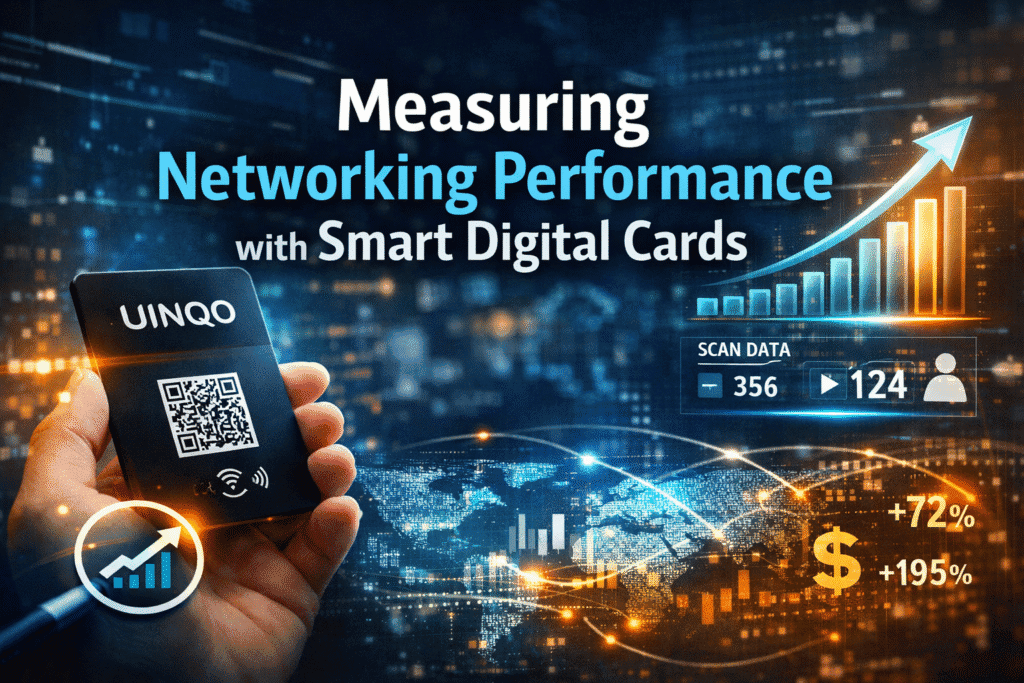
Digital cards transform how networking results are measured. When someone taps your NFC card or scans your dynamic QR code, the interaction is automatically recorded. Instead of guessing whether your details were noticed, UINQO lets you view real engagement data instantly. You can see how many people scanned your card, how many unique visitors viewed your page, and how many saved your contact, giving you clear insight into your real networking impact
This transformation moves networking from passive distribution to active engagement tracking. It aligns perfectly with the broader digital marketing ecosystem, where every click and interaction are measured. Now, networking operates with the same analytical discipline as online campaigns.
Understanding Scan Tracking: What Actually Gets Measured
When someone scans your NFC-enabled card or dynamic QR code, much more happens behind the scenes than you might expect. Scan tracking tools don’t just tally the number of scans they show you how people interact with your digital profile. You can see the total number of scans, understand the referral source of each interaction for example, whether someone scanned your card directly at a networking event, clicked a URL of your profile you shared in an email, or accessed it through a social media post track engagement with links, such as contact buttons and profiles, and even see the location, like the city or country where your card was accessed (if enabled). By measuring these, you gain actionable insights into which events, locations, or campaigns bring the most valuable connections. Instead of guessing who noticed your card, you know for sure and can follow up smarter.
Platforms such as UINQO integrate these tracking capabilities into a centralized dashboard. Instead of scattered information, professionals can monitor all activity from one interface. This unification of hardware interaction and software analytics is what makes digital cards powerful for performance tracking.
Moving Beyond Vanity Metrics
Scan counts alone are not enough. While it is useful to know how many people interacted with your card, raw numbers can be misleading. The true value lies in understanding behavior after the initial scan.
A meaningful networking metric considers multiple stages of engagement. Did the visitor explore your profile? Did they save your contact? Did they schedule a meeting? Each step in this journey reflects increasing intent. For data-driven professionals, this is similar to analyzing a sales funnel. The first scan represents awareness. Direct contact reflects conversion. By mapping these stages, networking becomes measurable in the same structured way as digital marketing campaigns.
Calculating Networking ROI in Practical Terms
Traditionally, measuring the return on investment (ROI) from networking has been tricky. You could track travel costs, event fees, and time spent, but linking those directly to actual business outcomes was mostly guesswork.
With UINQO’s digital cards, networking ROI becomes tangible. When you share your card at a conference, every scan is automatically tracked who scanned it, where, and which profile URL or contact options they engaged with. You can see exactly which connections converted into meaningful leads and compare potential revenue from those clients to the cost of attending the event. Networking stops being a hopeful exercise and becomes a measurable, data-driven performance channel.
Plus, UINQO integrates seamlessly with smart contact management, automatically organizing leads into categories so your follow-ups are structured, timely, and strategic ensuring no opportunity slips through the cracks.
Switch Profiles: Present the Right Version of Yourself
Switch Profiles gives you full control over which version of your digital business card is visible, all within a single account. There’s no need to create multiple accounts or generate separate QR codes for different scenarios. You simply select the profile that best fits the situation, ensuring your audience sees exactly what you want them to see.
For example, during a business meeting, you might display your professional corporate profile to highlight your experience and expertise. When pitching to a client, you could switch to a creative portfolio profile that showcases your projects and accomplishments. At networking events or conferences, you can present an event-specific profile designed to engage attendees and capture leads.
Each profile can be fully customized with unique links, contact options, social channels, and branding elements. This ensures that every interaction is relevant, purposeful, and strategic. With Switch Profiles, you present yourself with confidence and precision, making it easier to engage connections, generate leads, and leave a lasting impression. It transforms networking into a streamlined, professional, and data-informed process.
.Real-Time Data and Event Performance Analysis
One of the strongest advantages of digital card analytics is real-time visibility. During a networking event, you can observe scan activity as it happens. This provides immediate feedback on engagement levels.
For example, if analytics reveal that most visitors click on your contact details or scans your QR code but do not proceed to save your information or reach out, it may indicate friction in your communication flow. Perhaps your call-to-action is unclear, your profile lacks compelling information, or your value proposition needs refinement. Data does not simply measure outcomes; it highlights where engagement slows down and shows you exactly where optimization is needed. Over time, comparing scan data across multiple events reveals patterns. Perhaps trade shows generate more initial scans, but industry meetups produce higher conversion rates. Such insights allow professionals to allocate their time and budget more strategically.
This level of performance analysis was nearly impossible with traditional cards. Digital platforms now bring networking into the era of measurable experimentation.
Smart Contact Categorization and Follow-Up Efficiency
Data is only valuable if it leads to action. Capturing scan metrics is the first step; organizing and nurturing those contacts is the next. Smart contact categorization allows you to segment leads based on context, interest, or event type.
Instead of manually sorting stacks of paper cards, digital systems automatically store and categorize contacts. You can tag them as potential clients, collaborators, partners, or media contacts. This segmentation improves follow-up accuracy.
The Email Follow-Up feature allows you to efficiently send emails to selected contacts by choosing a specific category or group. Instead of manually sending messages to each individual, you can target an entire group at once. For example, attendees from a particular event, potential business leads, or professionals within a specific industry. This not only saves you time but also ensures that your communications are organized and purposeful. With this feature, you have complete control over who receives your message, making it easier to nurture relationships, stay connected, and maintain consistent engagement with your network.
By integrating tracking, categorization, and contact management, digital card ecosystems turn networking into a repeatable, optimized process rather than a random collection of interactions.
Privacy, Transparency, and Ethical Data Use
As with any data-driven system, responsible data handling is essential. Professionals must ensure that analytics are used ethically and transparently. Visitors should understand that their interaction generates engagement data, and platforms must comply with relevant privacy regulations.
Modern digital card solutions prioritize secure storage and controlled data access. This balance between insight and privacy builds trust. After all, the purpose of tracking scans is not surveillance; it is performance improvement. When implemented responsibly, analytics enhance professionalism rather than compromise it.
Seamless Lead Capture: Turning Connections into Opportunities
For marketers, digital business cards should not exist in isolation they work best when integrated into your broader marketing strategy. UINQO’s Lead Capture feature makes collecting and managing leads simple and efficient, all within a single profile. Whenever someone fills out your contact form, their information is automatically saved and organized under categories you’ve set, keeping everything structured and easy to manage. You can also scan physical business cards to capture contacts instantly, with all details neatly stored for easy access. After networking events, trade shows, or client meetings, all your leads are in one place, ready for follow-up. Each contact is organized to help you prioritize prospects, track engagement, and manage relationships efficiently.
By unifying lead capture with landing pages, analytics, and contact management, UINQO ensures that every connection from first tap to long-term collaboration is recorded accurately, allowing you to follow up smoothly, strategically, and with confidence.
Measuring Long-Term Relationship Value
ROI is not always immediate. Some networking connections mature over months or years. Digital tracking helps maintain visibility into long-term relationship development. By monitoring repeat visits to your profile or multiple interactions from the same contact, you can identify sustained interest. This indicates relationship depth beyond a single meeting.
Perhaps certain industries show higher engagement at specific times of year. Recognizing these patterns allows you to time outreach more effectively. The ability to track relationship momentum over time elevates networking from short-term lead generation to strategic relationship management.
The Future of Intelligent Networking
The integration of NFC technology, dynamic QR code, personalized digital identities, and advanced analytics signals a broader transformation in professional interaction. Networking is no longer just about exchanging information. It is about measuring impact, refining strategy, and continuously optimizing communication. As professionals increasingly demand accountability for time and budget investments, measurable networking will become the standard rather than the exception. Smart digital cards provide the infrastructure for this shift.
By combining elegant physical design, such as premium Metal or Bamboo cards, with robust data tracking and centralized management, platforms like UINQO represent the next stage of professional connectivity. In a world where every marketing channel is measured, networking should not remain in the dark. With digital cards, each tap tells a story. Each scan becomes a data point. And each data point brings professionals closer to understanding the true return on their relationships.
When networking becomes measurable, it becomes strategic. And when it becomes strategic, it becomes powerful.