Networking today appears more advanced than ever before. At conferences, meetups, and remote events, professionals exchange information instantly, sometimes without a single paper card changing hands. Yet despite this evolution, the fundamental challenge remains: traditional networking rarely leads to meaningful, lasting relationships. The reason isn’t simply a lack of digital tools it is the absence of a structured system to manage contacts after the first handshake or LinkedIn connection.
For decades, professionals have relied on paper business cards, scribbled notes, and memory to navigate their networks. These approaches were slow, clumsy, and ultimately unsustainable. With stacks of cards piling up in desk drawers and contact information scattered across email inboxes, networking became chaotic and inconsistent. Memory falters, details fade, and context disappears. You may remember a name, but the relevance of that connection who they are, why you met them, and how you can help each other slips away with time.
Traditional networking tools did one thing well: they got people connected. But they consistently failed at the next essential stage turning those connections into relationships. That moment when contact details are exchanged has always been treated as the “end” of the networking process when, in reality, it marks the beginning.
Today, as networking evolves to digital realms, this core problem persists. Digital business cards and QR codes have sped up the exchange, but many professionals find themselves still struggling with what comes after the first connection: how to organize, track, and grow every relationship into something long‑term and valuable.
Why Digital Business Card Apps Alone Are Not Enough
The introduction of digital business card apps has solved one major limitation of traditional networking: speed. No longer must you fumble with paper cards or manually type contact information into a smartphone. With a quick scan of a QR code or a tap of an NFC card, details transfer instantly into a device. Solutions like HiHello, About.me, and Bump (now largely integrated into contact sharing features on phones) showcase how fast and seamless sharing can be.
However, these tools focus almost exclusively on the initial exchange. They create a digital version of a business card, but they stop there. Once the information lands in your phone or CRM upload, the data often remains isolated, unstructured, or disconnected from context. The result is familiar: contacts are collected, but not cultivated; connections are made, but not maintained.
Without integrated contact management, digital business card apps become merely fancy Rolodex replacements. They offer convenience, but not strategy. You might have 500 contacts saved through multiple apps, but can you recall which event you met each person at? Do you know why you connected, what interests you shared, or what action you planned to take next? Most digital card solutions do not address these questions, yet they are critical to turning connections into opportunities.
For networking to be truly effective, professionals need more than a digital card, they need a system that brings order and context to the chaos. That system must automatically capture meaningful metadata, record relevant events, and guide follow‑ups with purpose. This is where digital business card apps fall short: they simplify sharing, but not relationship building.
The Role of Contact Management in Modern Networking
This is where the concept of contact management becomes a game‑changer. Contact management transforms a flat list of names into a living, organized network with context, categories, and relevance. Instead of leaving contacts scattered across multiple apps, inboxes, or notes, contact management centralizes every interaction into a unified ecosystem.
Think of contact management as the nervous system of networking while digital business card apps serve as the sensory organs that detect and collect contact information, contact management interprets, stores, and applies that information in ways that generate value.
Here’s how contact management changes the game:
Centralized and Organized Relationships
Rather than storing contacts in silos (phone contacts, email, LinkedIn, messaging apps), contact management consolidates them into one structured database. This unified view allows professionals to see not only names and emails, but also context where they met, in what setting, and why the connection was important.
For example, instead of remembering that Jane Doe is a marketing consultant, modern contact management lets you tag her under categories like “Event Partner,” “Conference Speaker,” or “Potential Client.” This makes it easier to search, recall, and prioritize relevant contacts when the time comes to follow up.
Context and History You Can Act On
Context is the lifeblood of effective networking. A connection without context is like a memory without emotion easy to forget. Contact management captures context automatically. It logs where and when interactions happened, notes added afterward, and even integration with calendar or CRM systems when appropriate.
Imagine you met someone at a tech conference in Lisbon. A digital business card app might save their contact details, but it won’t remind you why you connected or what you discussed. Contact management goes further reminding you to follow up on that specific topic you spoke about, like a potential collaboration on an upcoming project.
Strategic Follow‑Ups, Not Passive Memory
Most professionals rely on memory or random reminders to stay in touch. This leads inevitably to missed opportunities. Contact management eliminates this unpredictability by turning follow‑ups into intentional actions. Professionals can schedule reminders, set priorities, and even automate messages based on context.
Rather than waiting until you remember to reach out, contact management prompts you at the right time, turning networking from reactive to proactive.
Relationship Growth as a Measurable Process
Contact management also turns networking into something measurable. By tracking engagement, follow‑up timelines, and interaction frequency, professionals can gain insight into which connections matter most. Rather than collecting contacts indiscriminately, users can focus energy on relationships that have real potential for collaboration, growth, or mutual benefit.
This Smart Analytics for Networking is what separates scattered contact lists from powerful, strategic networks.
How Analytics Improves Digital Business Card Apps
While digital business card apps simplify the exchange of contact information, adding analytics elevates their impact. Analytics provide data‑driven insight into how networking efforts are performing and where improvements can be made.
Here are key ways analytics enhance digital business card apps:
Understanding Engagement Patterns
Analytics can reveal which contacts are actively engaging with your profile or follow‑ups. Who opened your digital card after a conference? Who revisited your profile multiple times? This insight helps professionals prioritize outreach, tailor communication, and understand where interest is strongest.
For example, if someone scans your card but never responds to a follow‑up message, analytics might prompt a different approach like a personalized message referencing a shared interest or event discussion.
Identifying Networking Hotspots
By analyzing data across events, industries, and interaction patterns, analytics can reveal where your best connections are happening. Perhaps you’re generating more opportunities from certain types of events, industries, or geographic locations. These insights can inform future networking strategies, helping you invest time where it counts most.
Personalized Follow‑Up Strategies
Rather than sending generic follow‑up messages, analytics can help tailor communication based on behavior. If a contact frequently revisits your profile or engages with certain content, that information becomes a valuable cue for how to approach them. Personalized engagement significantly increases the chances of nurturing a relationship successfully.
Tracking ROI of Networking Efforts
For professionals and businesses alike, networking investments should be measurable. With analytics attached to a digital business card app and contact management ecosystem, you can track metrics like response rate, connection growth, collaboration outcomes, and more. This transforms networking from a soft skill into a strategic business function.
Turning Contacts Into Business Opportunities
The ultimate goal of networking is not simply to collect names but to turn contacts into opportunities whether that means partnerships, clients, talent, or referrals. Contact management acts as the bridge between connection and opportunity by ensuring relationships are nurtured intentionally.
Here are key ways contact management facilitates this:
Intentional Follow‑Ups
Follow‑ups are where most networking efforts fail. A study published by Harvard Business Review found that the odds of converting a prospect increase significantly when a follow‑up happens within 24 hours of contact. Yet without a system to remind and prioritize follow‑ups, many opportunities go cold.
Contact management ensures follow‑ups are timely and meaningful. With automated reminders, categorized contacts, and follow‑up templates, professionals can engage consistently and thoughtfully.
Turning Casual Connections Into Strategic Assets
Contact management is particularly effective at turning casual connections into strategic assets because it provides the why and when for engagement. Rather than reaching out randomly, you can reconnect at moments that matter: when someone changes roles, when a project they mentioned comes to fruition, or when you share a mutual update.
These touchpoints turn routine networking into relationship cultivation where each interaction has purpose and potential.
Real‑World Example: UINQO’s Integrated Approach
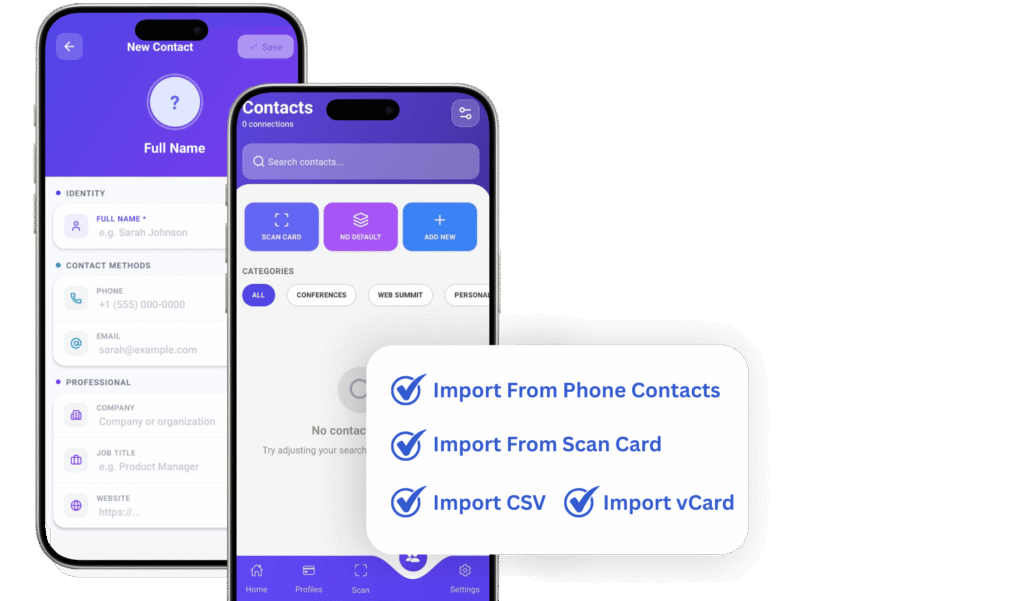
One powerful example of this approach in action is UINQO, a unified platform that combines digital business card functionality with a smart contact management backbone. Instead of treating digital card sharing as the final step, UINQO routes every connection into a centralized system where contacts are automatically categorized, stored with context, and ready for meaningful engagement. The platform also makes it easy to bring existing networks into one organized space through multiple import options. Users can import contacts directly from their phone contact list, ensuring previously saved connections become part of the organized database.
In addition, UINQO supports importing contacts by scanning physical business cards, allowing traditional cards to be digitized instantly. Professionals can also import CSV files (CSC/CSV format) to upload large contact lists from spreadsheets or other systems, and import vCard files (VCF) to seamlessly transfer contact information from email signatures, shared digital cards, or other networking platforms. By supporting these multiple import methods alongside NFC cards, QR code, and dynamic digital profiles, UINQO ensures that both new and existing connections are unified within a single intelligent contact management environment, eliminating scattered data and turning contacts into actionable professional relationships.
UINQO’s digital business card app allows professionals to share details instantly through NFC cards, QR code, or dynamic profiles. But what truly elevates the experience is the integrated contact management system that captures every touchpoint intelligently reducing manual entry, eliminating scattered data, and turning connections into actionable relationships.
UINQO also supports personalized landing pages and multiple profile versions, allowing users to present different professional identities depending on the networking situation. This ensures that first impressions match long‑term engagement strategies, aligning contact management with the evolving needs of modern professionals.
With features such as smart contact categories, easy search tools, and automated follow‑up reminders, UINQO demonstrates how combining a digital business card app with deep contact management capabilities transforms networking into a strategic, purpose‑driven process.
Conclusion: A Shift From Exchange to Engagement
Networking is not measured by the number of contacts collected, but by the quality and growth of relationships developed over time. While digital business card apps have modernized the way professionals share information, they fall short when it comes to the most important phase sustained engagement and opportunity creation.
The missing link in modern networking is contact management. It provides structure, context, and strategy turning fleeting interactions into long‑term value. By centralizing contacts, capturing meaningful context, and enabling intelligent follow‑ups, contact management bridges the gap between a connection and a relationship.
In an age where first impressions are fast and digital exchanges are instantaneous, the real advantage goes to those who can organize, nurture, and grow their networks with intention. Contact management is not an optional add‑on; it is the foundation that transforms networking from transactional to transformational.
For professionals who want every connection to count, the future of networking lies not only in smart sharing but in smart relationships. Integrating a digital business card app with a comprehensive contact management system like the approach pioneered by UINQO empowers individuals and teams to build networks that are not only vast, but meaningful, strategic, and enduring.