2025: The Business Card Exchange Goes Digital
Moments that once felt meaningful were reduced to small pieces of paper with fading ink. For years, exchanging paper business cards, with their tactile charm, have long served as the primary medium for sharing contact information. They were efficient, recognizable, and essential for establishing new connections. But as we move further into the digital era, these small rectangles of paper are no longer the smartest or most sustainable choice. Professionals today are demanding solutions that are flexible, eco-conscious, and technologically advanced. The way we connect, introduce ourselves, and build networks is evolving and digital business cards are at the forefront of this transformation.
Business card exchanges have always carried a subtle social importance. Handing over a card was more than just sharing contact information; it was a gesture of professionalism, a signal of readiness to collaborate, and a first impression in tangible form. Yet despite their historical significance, traditional cards have limitations that modern professionals can no longer overlook. Paper cards are easily misplaced, become outdated as information changes, and contribute significantly to environmental waste.
Why Paper Business Cards Are Becoming Obsolete
The decline of paper business cards is not just about convenience; it reflects broader changes in professional behavior, technological advancement, and environmental awareness. For decades, business cards were essential tools, ensuring that your contacts could reach you. However, the rapid adoption of smartphones, digital profiles, and professional networking platforms has made the traditional business card less relevant. Today, a professional’s contact information can be shared instantly through a phone, email, or cloud-based profile. Holding onto paper cards, which require printing, distribution, and frequent replacement, simply does not make sense in the digital-first world of 2025.
Paper business cards also pose a problem for sustainability-conscious professionals. Each card represents paper, ink, and production energy resources that contribute to environmental degradation. Unlike their digital counterparts, paper cards have no longevity or adaptability. A printed card cannot be updated if your job title changes, your email address changes, or your portfolio evolves. In contrast, a digital card can be edited in real-time, ensuring that every connection receives your most current and accurate information.
Problems with Traditional Business Cards
Beyond environmental concerns, paper cards are simply inconvenient in the modern professional landscape. They are easy to lose, can get damaged, and may be forgotten entirely during networking events or meetings. They do not allow for multimedia content such as portfolios, video introductions, or social media links, limiting the richness of your professional identity. Moreover, storing paper cards from dozens of networking encounters becomes cumbersome, with professionals often resorting to boxes or drawers full of outdated cards that rarely get revisited.
In the fast-paced, mobile-driven environment of contemporary business, waiting to manually enter a contact from a paper card into your phone is inefficient and prone to error. One missed digit or a misread email address can cause a missed opportunity. The result is a system that is no longer compatible with the speed and demands of modern networking.
Benefits of Digital Business Cards
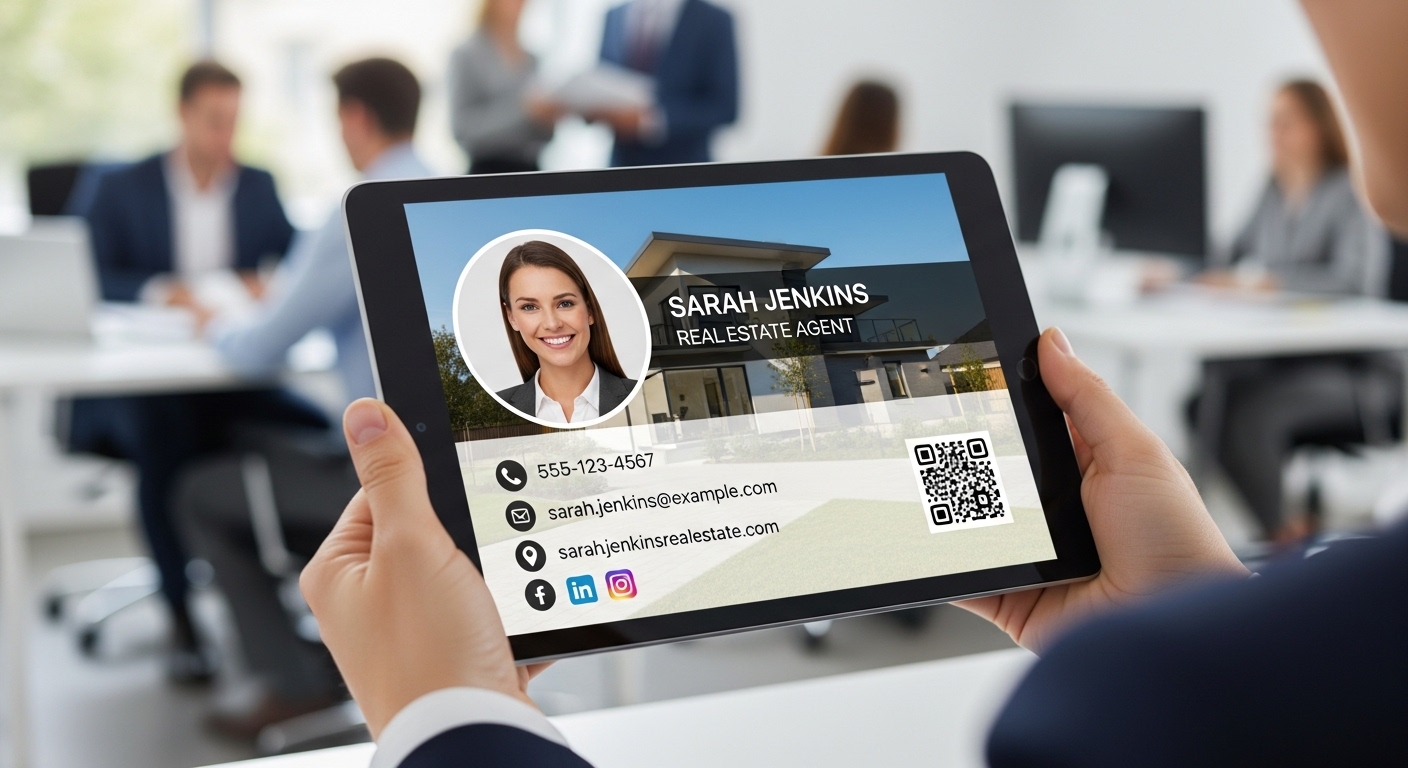
Digital business cards address all these challenges while offering far greater benefits. They are fully virtual, customizable, and instantly shareable with a tap, scan, or link. Unlike static paper cards, digital cards are dynamic. They can include contact details, social media links, a professional portfolio, and even video introductions. This added functionality allows professionals to communicate more than just a name and email address that they convey expertise, personality, and value in one compact, interactive format.
The flexibility of digital cards also ensures that your information is always accurate. Change your phone number, update your portfolio, or refresh your social media links, and every person you’ve shared your digital card with will see the updates automatically. This eliminates the confusion and inefficiency of distributing outdated paper cards and reinforces a professional image that is current and reliable.
Digital business cards are particularly advantageous in terms of cost and sustainability. Printing traditional cards incurs expenses for paper, ink, and distribution. Over time, these costs add up, especially for startups, freelancers, and small businesses operating with lean budgets. In contrast, digital cards require no printing, shipping, or physical storage, making them far more economical and environmentally friendly. They offer a smarter alternative that aligns with the eco-conscious values of today’s professionals, reducing waste while maintaining a polished, professional presence.
How NFC and QR Code Cards Work
The rise of digital business cards has been accelerated by technologies like NFC (Near Field Communication) and QR code. NFC-enabled cards allow professionals to share contact details simply by tapping their phone on the card. It’s fast, intuitive, and requires no manual entry. QR code provide a similar function, enabling instant access to your professional profile, portfolio, or contact information with just a quick scan. Both technologies enhance the networking experience, making it faster, smarter, and more interactive.
For instance, when attending conferences or networking events, sharing a digital card via NFC or QR code eliminates the need for physical exchanges. You can instantly deliver your professional information to dozens of contacts in seconds, a process that would take hours with paper cards. Some digital platforms even allow for interactive content, such as video messages or portfolio previews, making the connection far more engaging and memorable than handing over a traditional card.
Why Professionals Are Switching to Digital Cards
The shift to digital business cards is being driven by both practical and cultural factors. Professionals today prioritize efficiency, adaptability, and sustainability. The convenience of sharing and updating information instantly aligns perfectly with a fast-paced digital lifestyle. Digital cards also reflect a modern professional image, signaling that you are tech-savvy, forward-thinking, and environmentally aware. In competitive industries, these subtle cues can make a significant difference in how colleagues, clients, and prospects perceive you.
Real-world examples of successful digital card adoption illustrate their effectiveness. Consider a marketing executive who attends multiple industry events every month. With traditional cards, they might run through hundreds of paper cards, only for most to be lost or discarded. With a digital business card, the same executive can share information seamlessly, track interactions, and ensure that every contact receives the most up-to-date details. This approach is not only more efficient but also builds a stronger professional network over time.
Why UINQO Is the Future of Networking
Among the digital business card platforms, UINQO stands out as a forward-thinking solution for modern professionals. UINQO transforms networking into a structured, intelligent process. It allows users to create a fully customizable digital profile, share contact information instantly, and track connections in an organized dashboard. Instead of collecting random business cards or relying on memory, professionals can manage every relationship efficiently, keeping context-rich records and ensuring follow-ups are timely and relevant.
UINQO’s platform also integrates seamlessly with NFC or QR code technology, enabling dynamic sharing of information. For example, with the UINQO app, a single digital profile can be scanned or tapped to instantly share your latest portfolio, updated professional details, or even event-specific information. Unlike paper cards, your profile is always current and editable in real time, ensuring that every interaction stays relevant. This helps professionals maintain credibility, build trust, and present themselves with confidence in every networking moment.
Moreover, UINQO supports eco-conscious networking. By reducing reliance on paper, it contributes to sustainability goals while simultaneously enhancing professional efficiency. In a world where both time and environmental responsibility are valuable, UINQO provides the best of both worlds.
Networking in the Digital Age
Today, networking is no longer confined to in-person meetings. Smartphones, social media, and digital communication have expanded the reach of professional connections. Digital business cards perfectly fit this paradigm, allowing professionals to share information instantly, regardless of physical location. Whether at a virtual conference, an online seminar, or an international business meeting, your digital card ensures that connections are made seamlessly.
The integration of augmented reality (AR) is further enhancing networking experiences. Scanning a QR code on a digital card could open a 3D portfolio, an interactive company profile, or even a short-personalized video message. These capabilities make interactions more personal, engaging, and memorable that something that traditional paper cards could never achieve.
Cost and Sustainability Benefits Revisited
While the convenience and modern appeal of digital cards are compelling, the financial and environmental advantages become even clearer when you look at real numbers. Around 100 billion business cards are printed globally each year, and nearly 88% are thrown away within a week. Printing 500 standard business cards typically costs between $20 and $60, depending on quality. If a professional update their details just three times a year, annual printing costs can easily reach $150 to $300 per person. For a small company with 20 employees, that can mean $3,000 to $6,000 annually spent on cards alone. In contrast, digital business cards eliminate repeated printing costs entirely, allowing unlimited updates without additional production expenses.
From a sustainability perspective, the impact is significant. Producing 100 billion business cards requires an estimated 6 to 7 million trees every year, along with substantial amounts of water, ink, energy, and transportation. The pulp and paper industry are also responsible for roughly 2% of global industrial carbon emissions. When most cards are discarded almost immediately, the environmental cost becomes difficult to justify. Digital business cards remove the need for paper, ink, shipping, and reprints, dramatically reducing waste and lowering carbon footprint. By choosing digital over paper, professionals not only save money but also support a more sustainable, responsible business ecosystem.
Example Comparisons: Paper vs Digital
To understand the transformation more clearly, consider a comparison. A traditional business card requires printing, distribution, and manual updating. Losing a card can mean losing a contact, and outdated information requires reprinting thousands of copies. A digital card, however, can be shared instantly via NFC or QR code, updated in real-time, and accessed across devices without the risk of loss. This flexibility transforms networking from a static exchange into a dynamic, interactive experience.
Imagine attending a large industry conference. You exchange paper cards with 50 professionals, many of whom misplace them or discard them shortly afterward. With digital cards, all 50 contacts immediately have access to your current information, portfolio, and social links. Moreover, your digital platform may even allow you to track who viewed your card, providing valuable analytics to optimize your networking strategy.
The Future of Business Cards
As we move further into 2025, digital business cards are not just a trend; they are becoming the new standard. They offer a modern, flexible, and sustainable solution for professionals who want to maintain meaningful connections without the limitations of paper. By combining convenience, cost-efficiency, and eco-consciousness, digital cards redefine how professionals communicate, present themselves, and maintain relationships.
Digital business cards save time, reduce waste, and align perfectly with the values of today’s environmentally and technologically aware professionals. Platforms like UINQO make it simple to create, share, and manage digital identities, ensuring that every connection is meaningful, organized, and up-to-date. As technology continues to evolve, digital business cards will define professional networking seamlessly, intelligently, and sustainably.
By embracing digital business cards, professionals are no longer limited by paper, geography, or outdated methods. The shift is clear: the future of networking is digital, dynamic, and in your pocket, ready to share with a tap or a scan.
Upgrade Your Networking with UINQO. Create your digital business card and share your professional profile instantly with NFC or QR code.