




NFC vs QR Code Business Cards: Speed & Security
 Feb 13,2026
  By dev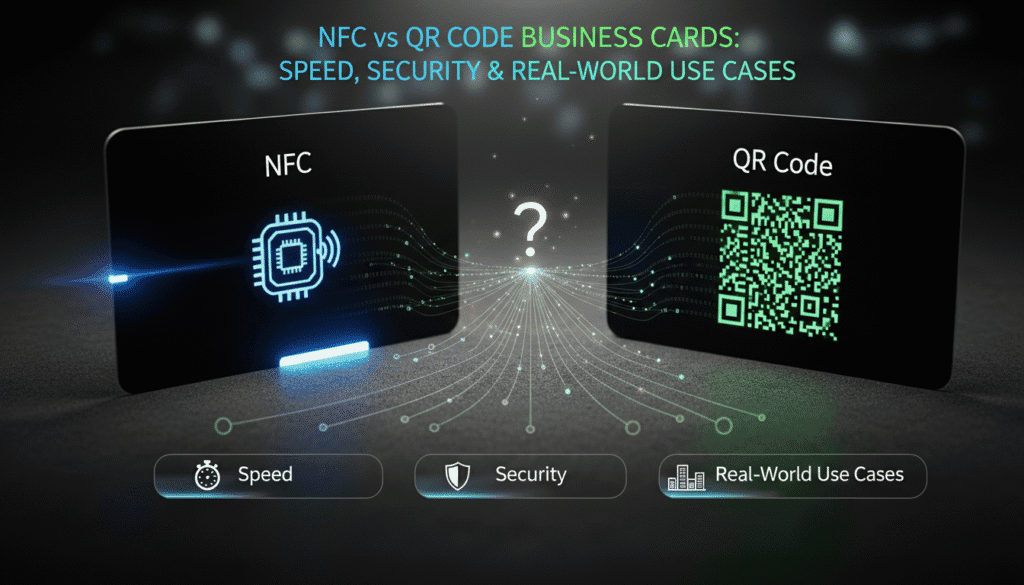
In the rapidly evolving landscape of professional networking, contactless digital business cards are no longer a futuristic novelty they are a modern necessity. As we move deeper into 2026, the traditional exchange of paper business cards is steadily giving way to smarter, faster, more efficient solutions that leverage contactless technologies like NFC (Near Field Communication) and QR code.
Professionals traveling between meetings, startups attending global conferences, and sales teams working hybrid schedules all face the same challenge: how do you exchange your contact information quickly, securely, and in a way that makes an impact? Enter the era of digital business cards and among the leading innovators in this space is UINQO, a platform that integrates both NFC and QR code technologies into elegant, versatile networking tools.
This comprehensive blog explores the differences between NFC and QR code business cards, comparing speed and security, and highlighting real use cases backed by statistics and industry insights. Throughout, we’ll explain how UINQO’s hybrid solutions solve the real networking pain points professionals encounter today.
The Rise of Digital Business Cards in Professional Networking
In 2026, the way professionals’ network has changed dramatically. While paper business cards were once ubiquitous, they are increasingly seen as inefficient and wasteful. According to industry research, approximately 62 % of professionals now prefer digital business cards over printed versions, citing seamless contact sharing and reduced waste as key drivers for the shift.
Traditional cards often fall short in today’s fast‑paced environments. They’ve long been criticized for being easily lost, quickly outdated, and inconvenient to store. In contrast, digital business cards whether shared via NFC or QR code that eliminate manual data entry, reduce physical waste, and allow users to update their information dynamically without reprinting. The result is a networking experience that aligns with how people communicate and connect in the modern world.
Platforms like UINQO build on this shift, offering smart cards that leverage digital technologies to create a seamless, impressive networking experience without the friction associated with physical cards.
What Is NFC and How Does It Work?
NFC, or Near Field Communication, is a short‑range wireless technology that enables two compatible devices to exchange information when placed very close to one another, usually within a couple of centimeters. In practical terms, an NFC‑enabled business card equipped with an NFC chip can transfer contact information to a smartphone with a simple tap. There’s no app to download, no QR code to scan, and no manual typing required the process takes less than a second.
Imagine you’re at a pitch meeting with a potential investor. Instead of fumbling with paper cards or asking them to open their camera app, you can simply tap your NFC card to their phone. Instantly, they receive your contact details, social profiles, and portfolio links, all without interrupting the flow of the conversation. This instant, frictionless exchange not only saves time but leaves a strong, professional impression.
NFC Adoption and Usage Trends
NFC has grown far beyond niche usage. As of 2024, approximately 78 % of smartphones shipped had NFC capability, a dramatic increase from 61 % in 2022. Market data also shows that over 126 million NFC business cards were in use worldwide by the end of 2024, illustrating how this technology has transitioned from early adopter circles to widespread professional application.
Despite these gains, NFC is not universally compatible with every mobile device. Roughly 87 % of smartphones globally support NFC, leaving about one in eight users unable to use tap‑based sharing unless there’s a fallback option like a QR code. That’s one of the reasons hybrid solutions that include both technologies are gaining traction a topic we’ll explore later in this post.
Understanding QR Code Business Cards and Their Benefits
QR codes are those square, pixelated symbols that, when scanned with a smartphone camera, direct users to a digital destination a URL, contact card, landing page, or portfolio site. Unlike NFC, QR codes don’t require any special hardware; virtually every modern smartphone camera can scan them, making them universally accessible.
QR codes can be printed on paper business cards, displayed on screens during presentations, included in email signatures, embedded in marketing materials like brochures and flyers, and even shared in virtual meetings. This versatility makes QR codes especially powerful in situations where physical proximity isn’t guaranteed but you still want recipients to access your professional profile instantly.
For example, consider a speaker wrapping up a keynote address at a global conference. Instead of handing out individual cards to hundreds of attendees, they project a QR code on the final slide of their presentation. Attendees scan the code with their smartphones and instantly access the speaker’s contact information and resources a simple, elegant solution that combines efficiency with reach.
Speed Comparison: NFC Vs QR Codes
One of the most frequently discussed points in the NFC vs QR code debate is speed of use.
NFC generally has the advantage when it comes to speed. A tap‑to‑share NFC interaction completes in under a second, whereas scanning a QR code which requires unlocking the phone, opening the camera app (if not automatic), aiming it at the code, and waiting for the link to load can take several seconds. In high‑velocity networking environments like trade shows, sales meetings, or investor introductions, this difference can feel significant.
However, speed isn’t always the full story. While NFC is nearly instantaneous, QR codes offer universal compatibility. According to data from deployments across industries, QR‑only solutions show a higher adoption rate (about 92 %) than NFC‑only solutions (about 78 %). That’s because QR code scanning works on every smartphone, which means fewer people are left unable to engage with a given card.
A combined, hybrid card that offers both tap‑to‑share NFC and a scannable QR code can achieve adoption rates as high as 96 %, effectively covering nearly all users regardless of device capabilities.
Security Considerations: NFC Vs QR Codes
Security is a critical piece of the modern networking experience, especially in industries where sensitive contact information, proprietary links, or client details are being exchanged.
NFC has built‑in security advantages because the short proximity range required for communication (typically less than 4 cm) makes it difficult for malicious actors to intercept or scan the data remotely. In addition, secure NFC implementations use encrypted communication protocols, adding an extra layer of protection.
QR codes, by contrast, are inherently publicly visible symbols. While the code itself doesn’t contain sensitive data (usually just a URL), users must rely on secure landing pages (HTTPS) and verification mechanisms to ensure that they aren’t being directed to malicious destinations. When QR codes are integrated with reputable platforms like UINQO, secure protocols and controlled access settings help mitigate these risks and ensure that users’ information remains protected.
In real life, consider two professionals at a security conference. One hands over an NFC card with encrypted links to a secure digital profile; the other hands a QR code that points to a website requiring HTTPS and identity verification. Both accomplish the same goal to sharing contact details but the NFC interaction adds a layer of built‑in security that reduces the chances of unintended data interception.
Real‑World Use Cases
NFC in One‑on‑One Networking
NFC business cards excel in face‑to‑face interactions. A sales executive at a trade show can tap an NFC card to a potential client’s device and immediately share contact information, portfolio links, and follow‑up options like meeting scheduling buttons. This eliminates awkward fumbling with traditional cards or lost opportunities due to manual entry errors.
One enterprise user shared that their team’s leads converted at higher rates after switching to NFC cards, as the immediate exchange left a professional impression and customers could save contact details without effort. These real‑world advantages contribute to why over 58 % of corporate sales team’s report using NFC cards to streamline networking at industry events.
QR Codes for Broad Outreach
QR codes shine in broad outreach scenarios where proximity isn’t guaranteed. For instance, a marketing manager might include a QR code on printed brochures distributed at a public expo. Recipients who pick up these brochures can scan and instantly access a landing page with company information, promotional offers, and links to connect. Because QR codes don’t require hardware compatibility, they work seamlessly across older and newer devices alike.
Imagine a consultant who speaks at a virtual webinar. Instead of handing out individual details via private messages, they share a QR code during the session. Attendees scan it with a click and instantly access the consultant’s digital business card, LinkedIn profile, and scheduling calendar all without leaving their screen.
Hybrid Use: The Best of Both Worlds
The most effective professional networking often blends NFC and QR code mediums. At a conference, an attendee can tap your NFC card during personal introductions and later scan your QR code from your email signature or LinkedIn profile. This hybrid approach covers every audience and networking context.
Statistics support this strategy: hybrid NFC‑QR solutions grew 36 % between 2024 and 2025, reflecting professionals’ growing preference for flexible, universal networking tools.
How UINQO Solves Networking Challenges
While NFC and QR technologies each have distinct strengths, professionals face real challenges that go beyond choosing one over the other. Some of these include device compatibility gaps, data security concerns, lead tracking and follow‑up efficiency, and difficulties in organizing contacts after exchanges.
This is where UINQO’s integrated solutions shine.
Unified Networking Experience
UINQO offers smart digital business cards that seamlessly combine tap‑to‑share NFC and QR code scanning on a single card. This means you’re never forced to choose between speed and accessibility and you’re covered whether someone’s phone supports NFC or not.
Enhanced Contact Management
UINQO goes far beyond simple contact sharing. Every interaction, whether through an NFC tap or a QR code scan, is automatically saved in the app’s history, creating a comprehensive record of all networking activity. This historical log allows professionals to see exactly who they connected with, when the interaction occurred, and what details were shared. Over time, this creates a powerful database of contacts, giving users complete visibility into their networking efforts.
For example, a startup founder at a tech expo can tap their digital business card with dozens of prospective partners, then later review analytics showing who viewed their portfolio links, who clicked their services, and where the most engagement came from. This insight helps target follow‑ups and increases conversion rates a critical advantage in competitive environments.
Secure and Dynamic Information with the UINQO App
The UINQO app is designed with both security and flexibility in mind, transforming the way professionals manage and share their contact information. Unlike traditional methods, the app allows users to update their contact details, social links, portfolios, and even scheduling tools dynamically, ensuring that every connection always has access to the most current professional information. Updates made in the app are instantly reflected across all shared profiles, so whether someone connected with you last month or last week, they will see the latest version of your details without any additional steps.
Security is a central feature of the UINQO app. All data transfers are encrypted, access to profiles is fully controllable, and users can decide exactly what information is shared with each contact. Beyond sharing, the app functions as an intelligent contact management system, logging interactions from NFC taps or QR scans, tracking engagement, categorizing contacts, and enabling reminders for follow-ups.
By combining real-time updates, advanced security, and actionable insights, the UINQO app ensures that every professional connection is not only meaningful but secure and fully optimized for follow-up and growth.
Eco‑Friendly and Professional
With statistics showing that approximately 7 million trees are saved annually through digital business card adoption, professionals who use UINQO cards are not just improving efficiency, they’re signaling sustainable business practices. Additionally, premium NFC card materials like metal or bamboo create a memorable physical experience that enhances brand perception.
The Future of Professional Networking
The future of professional networking isn’t about paper vs digital. It’s about flexibility, efficiency, and connection. NFC and QR codes are part of a broader shift toward smart, measurable, contactless interactions that help professionals make every networking moment count.
Hybrid solutions like those offered by UINQO represent the next step. They ensure that whether you’re exchanging information at a global conference, sharing your profile remotely, or capturing analytics for strategic follow‑ups, you’re equipped with tools that work everywhere, every time. In 2026 and beyond, the goal is not just to share a business card, it’s to create a lasting professional connection. NFC and QR code business cards are more than technology; they’re gateways to smarter, faster, and more meaningful networking. With platforms like UINQO simplifying this process, professionals can focus on what truly matters building relationships that drive growth and success.